
The book · Coming early 2027
From Product to Profit
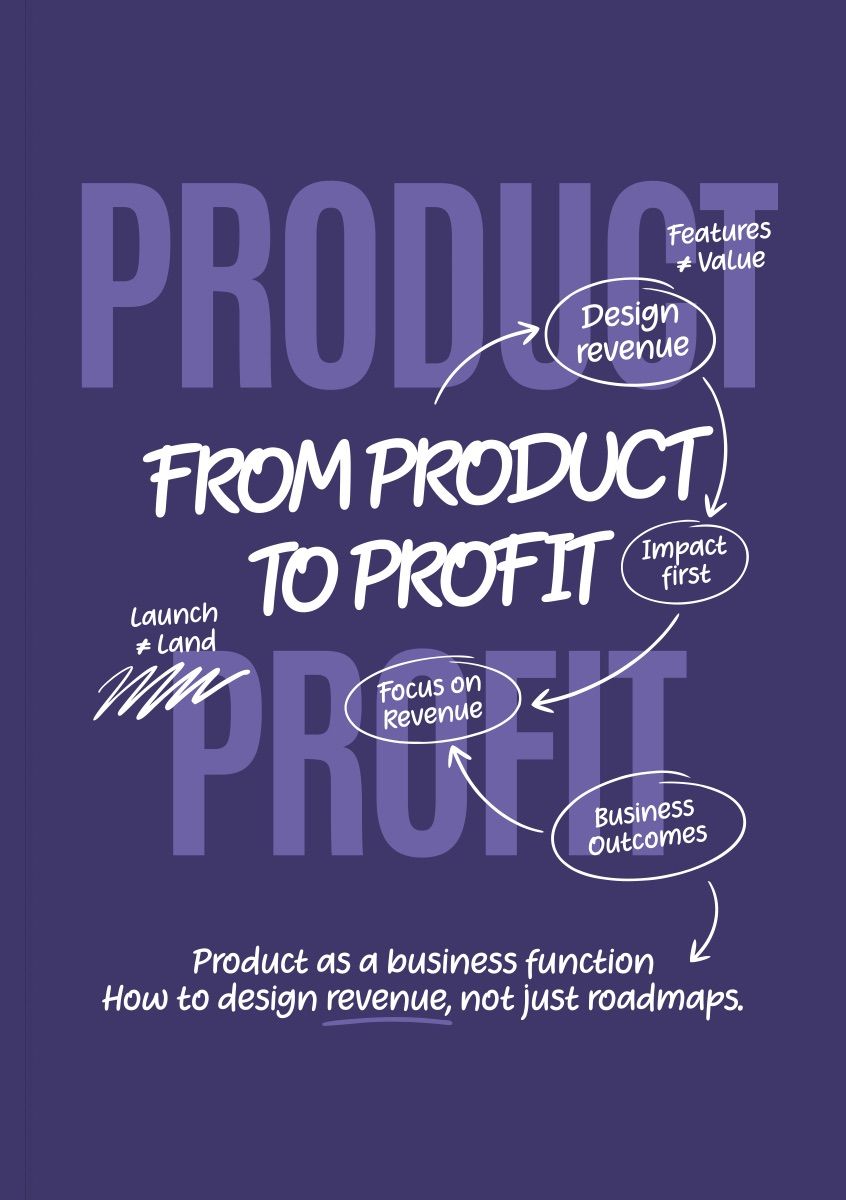
Product as a business function: how to design revenue, not just roadmaps.
Stop shipping features. Start designing revenue. If your product ships and your revenue does not follow, the missing link is in here.

In most companies, product and the business speak two languages that share almost no words. One side talks about discovery, velocity and the roadmap. The other talks about pipeline, margin and payback. That gap is where revenue goes to die. No amount of shipping closes it.
This book treats product as what it actually is: a business function that invests time, and time is money, and money owes a return.
It shows you how to read the board before you move a piece. How to beat the competitor that wins most of your deals, which is nobody, doing nothing. How to design a price and a distribution motion your economics can actually pay for, instead of inheriting the ones you hired first. And how to run a portfolio where the evidence moves the budget.
Coming early 2027. Get one email the day it comes out.
Check your inbox.
I sent a link to your email. One click on it confirms your address, and you are on the list.
For the people who carry the number.
Experienced people who want material they can defend in an executive committee on a Tuesday morning, and arguments that survive contact with finance.
Chief executives
If you own a number rather than a roadmap, read this as the case your product organisation has been failing to make to you.
Revenue leaders
You will be asked to fund all of this. Know which seat at the table needs a feature, and what it is worth to the deal.
Product leaders
Stop being treated as a supplier. Arrive speaking of return, payback period and new recurring revenue, and the conversation changes.
Product marketing leads
For the leads tired of watching excellent work fail to turn into revenue: the craft, carried on to the price, the packaging and the distribution.
Founders
Design a price and a distribution motion your economics can actually pay for, instead of inheriting the ones you hired first.
Anyone whose roadmap must show up in the P&L
Your roadmap is a budget. Every item on it is an investment of time, and time is money.
Four parts, in the order a business has to think.
Twelve chapters, one starter tool per chapter. Plus an introduction, The Missing Link, an interlude where I take the strongest objections seriously, and an epilogue.
Part 1UnderstandRead the board before you move a piece.
Part 2ShapeTie every opportunity to margin and payback.
Part 3LaunchOrchestrate the landing, not just the launch.
No master method. A toolbox.
Every chapter gives you a starter tool to adapt to your own context and your own numbers, never a recipe to follow blindly. Real companies with sourced numbers, and the failures set beside the wins, because the failures are where the mechanism shows.
One per chapter
Twelve starter tools
- 01The Terrain Read
- 02Reading the Real Competitor
- 03The Buying Table
- 04The Positioning Build
- 05Designing the Motion
- 06Designing the Price
- 07The Investment Board
- 08The Landing Plan
- 09The Demand Engine
- 10The Value Ladder
- 11The Evidence Loop
- 12The Operating Contract
Quick assessment · 12 questions
A score before page one
Twelve questions, one per chapter, twenty-four points. Your lowest scores are your reading order.
Take the Quick assessmentCompanion workbook · 50 pages
Worksheets for your own numbers
Every chapter closes on questions you answer with your figures. From chapter 2:
State in one sentence, with a number, what your prospect’s status quo costs them.
200+ sourced notes
Real companies, failures included
Adobe, Datadog, Intercom, BlaBlaCar, Pennylane and Slack, set beside Quibi, Clubhouse and Blockbuster. Where a figure is company-stated rather than audited, the page says so.
Five convictions. Every chapter traces back to one.
Under the whole argument sits one contract: product is a business function. It invests the company’s scarcest resource, time, and owes a measurable return. The five convictions are that contract, made specific.
Revenue is designed, not hoped for.
Pricing is the strongest lever you have, and the one almost nobody manages: set once at launch, then left alone. Revenue is not discovered, negotiated or copied from a competitor. You architect the price and the packaging, starting with the thing you charge for.
Chapter 6 · Designing RevenueThe status quo is your biggest competitor.
Most deals are not lost to a rival. They are lost to the customer doing nothing: the spreadsheet, the workaround, the inertia. It beats every rival on your grid combined, so make the cost of inaction expensive and take the risk of moving away.
Chapter 2 · The Enemy is InactionDistribution is part of the product.
How the thing reaches the customer is part of what you build. It sets your cost to acquire, your cost to serve and your reach, and it decides who wins more reliably than product quality does.
Chapter 5 · Designing DistributionActivation sets the ceiling.
Every customer’s lifetime value is capped at the moment they either reach value or do not. No amount of demand survives a customer who never gets there. Activation sets the ceiling; expansion raises it.
Chapter 10 · Activation and ExpansionEvidence beats opinion.
In a room full of smart, confident people, the opinion that wins is the one with the most power behind it, and power is not the same as being right. The loop you run finds the truth faster than the highest-paid person in the room can assert it.
Chapter 11 · The Feedback Loop
And under all five, one line: execution of the design beats the cleverness of the idea.
In the book’s own words.
Needing is free. Paying is the whole job.
Margin is what buys the next three years of caring about users.
It is product’s job to break its own glass ceiling.
Written from inside the problem.
I will not pretend I produced the numbers below. What I took from them is narrower: the job moved from what we built to what it earned.
- Sewan Six years · ending as Head of Product Marketing
The company grew from 30 to 500+ people, and annual recurring revenue went from €9M to €130M.
- rocket.pm Since 2023 · my own practice
VP Strategy with Kolecto, a Crédit Agricole Group venture, and Strategy & Performance Director at Doctolib.
The book I did not write first.
My first book project was about product marketing, called Build the Bridge. I dropped it after 280 pages and three rewrites, because the subject was bigger than one function: the skills of product marketing belong in every product role. From Product to Profit is the book that came out of that.
Score your company before you start.
Twelve questions, one per chapter. Your lowest scores are your reading order.
For press and publishers: mat@rocket.pm